Transaction Processing (T.P) (See Ref 1 for more info) traditionally comprises:
- Dumb terminal (thin client for user input)
- Send Request
- Accept Response
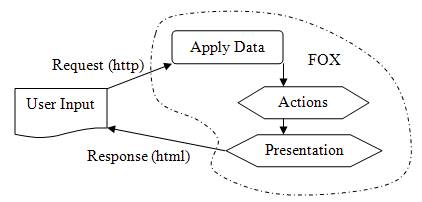
T.P is particularly suited to internet applications as the GUI is sent to the client, where user inputs are made, and then it is all sent back to the server for processing. There is no network chatter either before or after transmission of data.
FOX uses strict T.P cycles, which correspond to:
CONCEPTS
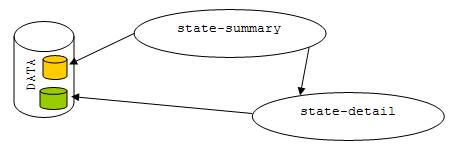
FOX STATES
- A fox state corresponds to a state on the State Transition GUI Design model (See Ref 2 for more info)
- A fox state is used to display data in a module
- Multiple states are used to display different views on the same data
EXAMPLE
FOX ACTIONS
- Fox actions are the actions performed along the state transition arrows
- Procedural part of Fox comprising a sequence of commands
- Most commands are 4GL (4th Generation Language) in nature
ATTACH POINT
- You have to be ‘attached’ to some element somewhere in the XML DOM
- The attach point gives you more control over subsequent XPaths
- An attach point is crucial when dealing with lists
EXAMPLES
Attached to: /*
In set-out: match=”/*/HISTORY”
Attach point has no effect, as XPath is absolute (i.e. from root)
Attached to: /*
In set-out: match=”HISTORY”
Attach point is used to locate HISTORY and as such is vital
Attached to: /*/SCHEDULE_LIST/SCHEDULE
In set-out: match=”./COMPANY_LIST”
Attach point is used to locate COMPANY_LIST and as such is vital. It is even more important given that SCHEDULE is a repeating type.
MODULE SECTIONS
<fm:state-list> Repeating group of states (usually only one) in a module
<fm:action-list> Repeating group of actions inside a module or state
<fm:presentation> Group of presentation commands inside module or state
FOX uses the current state definition of action-list and presentation to look for required actions/presentation buffers etc, before looking at module level.
REFERENCES
- Transaction Processing:
- http://en.wikipedia.org/wiki/Transaction_processing
- State Transition GUI Design model:
- PVCS\Fox\docs\System Docs\Fox Diagrams Master.ppt Slide 2